Mr. Joseph Whitworth produces a large display of guns and projectiles prepared on his system, which differs in many points from that of his great competitor and rival, Sir William Armstrong. Whitworth for a considerable time rejected “built-up” guns, and formed all natures of his ordnance, however heavy, of solid masses of what is called “homogeneous metal,” a puzzle-the-vulgar phrase, for tough steely iron, without fibre, i.e., with minute saccaroid crystallization. Latterly, however, he has employed for his larger guns in many instances this material in heavy thicknesses, for an internal tube, reinforced at the breech-end with one or more plies of rings, of the same, or of other qualities of iron, shrunk on with initial tension; and in this we are quite sure he is right.
Author: Research Press
Artillery, 1862: Armstrong Guns
The great display in the British division of Class 11 is made by the CONTRIBUTIONS FROM THE WAR DEPARTMENT, in all its divisions of service. From the Royal Carriage Department there is a very large collection of gun carriages for garrison, naval, and field service, with all their adjuncts, including all the recent alterations and improvements made on these in connection with the Armstrong guns. In the Gun Factory Departments the Armstrong guns themselves are represented by several mounted, and unmounted pieces, large and small.
Artillery, 1862: Competitive Trials, Rifled Guns, 1861
Results of the competitive trials for rifled guns at Shoeburyness in 1861. Tabular results in the most condensed form in which we can convey a certain amount of knowledge of this subject within our space.
Artillery, 1862: Projectiles and Rifling
In small arms the projectile of lead is so soft, small, and mouldable, that no serious difficulties are found in causing it to adapt itself to the spirals of the barrel, so as perfectly to take the spin without injury to the spirals; but the case is widely different in great guns. The mass of the projectile must be of rigid material, of iron or steel; either, then, some tertium quid of soft and mouldalde material, like lead, must be adapted to its exterior, that shall at the moment of projection adapt itself to the spirals also, or workmanship the most exquisite and precise must be employed to produce in each shot a rigid piston, perfectly fitting the spirals.
Artillery, 1862
The text and illustrations published here have been extracted from ‘RECORD OF THE INTERNATIONAL EXHIBITION, 1862’, published by William Mackenzie, Glasgow Edinburgh and London. The author gives brief historical introduction and proceeds to discussion of the then current state of development of artillery.
Pattern 1841 Carbine
Introducing a quite rare British longarm: The Pattern 1841 Royal Sappers & Miners, &/or Royal Artillery Carbine. This comes from the design of George Lovell and is the ultimate smoothbore. The 30 inch barrel is in the new Reduced Bore of .733, a reduction of .020 from the Regulation .753 of the Infantry Musket but intended to still use the same cartridge loaded with a ball of .685.
Rival Rifles
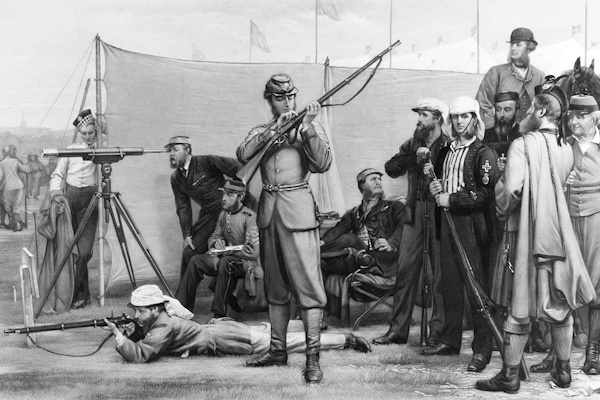
Trials were held at Hythe in May 1860 to select a suitable rifle for use in the Queen’s Prize at long range. Mr. Whitworth and a deputation of Birmingham gun makers contested the trials, with the Whitworth rifle being the clear winner. With one exception, the Whitworth rifle continued to be issued to Queen’s Prize finalists until 1871, when for the first time the match was shot throughout with breech-loaders. The notable exception was in 1865, when the Rigby rifle was issued to Queen’s Prize finalists.
George Charles Gibbs (1859–1918)
George C. Gibbs was a gifted shot and G.T Teasdale-Bucknell in his “Experts on Guns & Shooting” (1900) observed that he “would by rifle shots be conceded the first place in the British Islands as a long range rifle shot. This position G.C. Gibbs has gained by no single feat but by constant good shooting, varied only by occasional phenomenal feats.”
Pattern 1838 Musket
The days of the flintlock action were numbered when Alexander Forsyth began experiments, in 1805 in the Tower of London, aimed at harnessing the power of exploding fulminates as a means of ignition. His work was expanded upon by others which eventually led to the “Musket, Rank and File for Foot Guards”, the first percussion musket to be issued in quantity to British soldiers. Today we usually simply call it the Pattern 1838.
Historical Time Line – 1850-1854
1850-1854. This is a transcription of about 240 5”x3” Index Cards compiled by the late Tony Taylerson as a Chronological Reference System.
Historical Time Line – 1845-1849
1845-1849. This is a transcription of about 240 5”x3” Index Cards compiled by the late Tony Taylerson as a Chronological Reference System.