Biographic index of American riflemen.
Category: Marksmanship
Military marksmanship and target shooting. Instruction and historical.
Browse the latest posts below, or see:
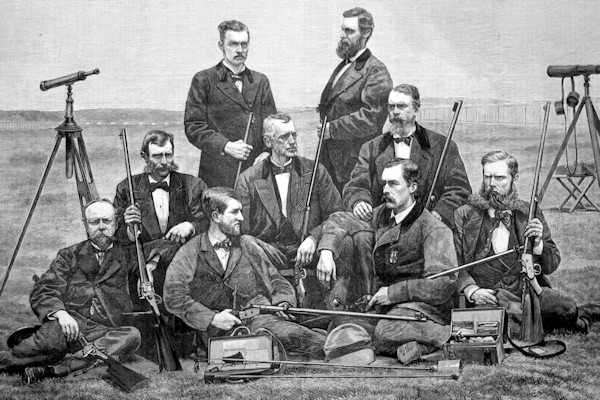
Charles W. Hinman (1849-1922)
Charles Hinman was born 11 April 1849 in West Concord, Vermont. He spent his boyhood on a farm, and devoted his leisure time to trapping. As Private Charles Hinman with 1st Regiment, Massachusetts Volunteer Militia, he represented the USA in the military rifle matches of 1882 and 1883 between British Rifle Volunteers and US National Guard. By 1888 and as a Major, he was assistant inspector-general rifle practice, First Brigade.
The Queen’s Prize
The National Rifle Association was founded in 1859 and held its first annual rifle meeting at Wimbledon in 1860. Queen Victoria fired the inaugural shot at the first rifle meeting on 2 July 1860. The Queen further offered encouragement by founding an annual prize that Volunteers competed for in two stages; originally the first stage was fired at 300, 500 and 600 yards, and the second at 800, 900 and 1000 yards. Prize money was £250.
Rifle Shooting In England
This article provides a brief overview of the progress of the National Rifle Association and rifle shooting in England in 1861, from a US perspective. This was the second year of the NRA’s Annual Rifle Meeting.
The Wimbledon Rifle-Match
Special trains had been running from Waterloo to Wimbledon throughout the ‘rifle-week,’ as fast as passengers accumulated at the station. On Saturday, when the Queen’s Prize was contended for, when what has been called the examination for double-first in rifle-shooting came on, crowds filled the carriages as fast as they could be got ready. We went down in the morning. Volunteers in all shades of uniform, with rifles, and pouches well stored with ammunition, were waiting on the platform, and took the train by assault as soon as it was formed.
A Talk About The National Rifle Association Meeting At Wimbledon
You were at Wimbledon, at the great national rifle meeting. By all the accounts I have seen of it, it must have been a great success; but I should like to hear some of the details from an eye-witness; so tell me about it, for I was confined to my post here by work of all sort. With J.C. Templer, Captain Commanding 18th Middlesex.
Thoughts on The Last Wimbledon Meeting
It must not be forgotten that the National Rifle Association Meeting affords the only meeting-place of friendly competition of Army, Navy, Militia, Yeomanry, and Volunteers; the only place at which our comrades in arms from the Channel Islands, Canada, Australia, India and other Colonies and possessions can test their progress, and give visible demonstration of their Imperial brotherhood to our home soldiers, our sailors and Volunteers. I look forward to the influence which the proximity of Bisley to Aldershot will have on the shooting of our soldiers and the friendly rivalry between the services as amongst the most important of the advantages we shall gain.
Lost
Some readers will no doubt have left something behind at a rifle range on occasion. Following are lists of items found at Wimbledon and Bisley during the National Rifle Association annual rifle meetings. The list are from 1867, 1875, 1887 and 1895.
Creedmoor and the International Rifle Matches
To trace the origins of the Creedmoor rifle range one needs to go back to the immediate post Civil War years in America. Understandably, at the time there was little interest in marksmanship or military matters from the general public, and although the US National Guard received plenty of drill and marching instruction there was scant, if any, marksmanship training. The impetus for the development of marksmanship skills within America’s National Guard units came from the pages of the Army and Navy Journal. The editor was William Church, and a kindred spirit was George Wingate, whose “Manual for Rifle Practice” appeared in six instalments in the Journal in late 1870 and early 1871. Reprinted in book form in a number of editions the manual became the standard work upon which rifle practice was developed in America.
‘Pickets’ versus Bullets
THE old regulation-musket, known in the army by the affectionate sobriquet of ‘Brown Bess,’ would sometimes, though not always, carry a bullet with a certain degree of precision about a hundred yards; but beyond that very moderate distance, no one, however expert, could make sure of hitting even a barn-door; the aim of the individual who pulled the trigger having very little to do with the direction taken by the projectile. We have lately had an opportunity of seeing a great many men trained to the use of the new arm; and it may interest the reader to learn something of the process by which the lad who has perhaps never fired a shot in his life, is converted into a more or less skilful rifleman.
Rifle Instruction in the USA
In the immediate post-Civil War years in America, there was understandably little interest in marksmanship or military matters from the general public. Whilst the US National Guard received plenty of drill and marching instruction there was scant, if any, marksmanship training. The impetus for the development of marksmanship skills within America’s National Guard units came from the pages of the Army and Navy Journal.
Breech Plugs
The long range muzzle loading rifle is a specialty of its own and has components that are not found on any other type of muzzle loader. The most important of these is the breech plug.