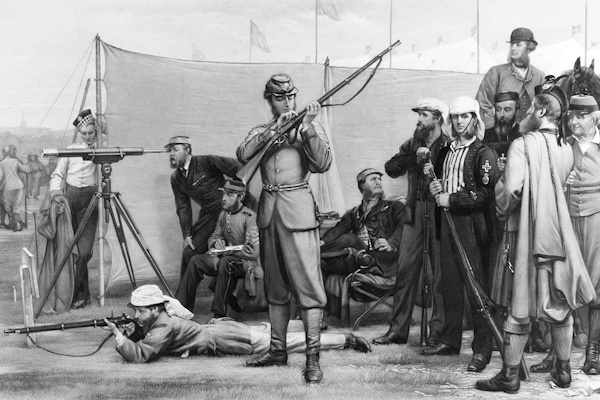
In 1893 the influential London magazine ‘The Strand’ published an illustrated interview with Sir Henry Halford. “The Grand Old Man of Shooting,” Sir Henry Halford revelled in records almost from the very first meeting at Wimbledon in 1860, and it is a remarkable fact that amongst his prizes are those of the Albert at Wimbledon in 1862 and the same trophy at Bisley in 1893, a record lapse of thirty-one years!
Category: Marksmanship
Military marksmanship and target shooting. Instruction and historical.
Browse the latest posts below, or see:
Men of The Hour: Sir Henry Halford
He is standing among the British team at Creedmoor. He watches the wind, directs every shot, knows the fate of each bullet before it reaches the target. A figure tall and erect; a commanding presence. His men obey him implicitly; he is their Marlborough, their Welllington. As the books write him down, he is Sir Henry St. John Halford, Bart., of Wistow Hall, in the County of Leicestershire, Lieutenant-Colonel of the Leicestershire Rifles.
Sir Henry Halford (1828-1897)
INDEX. “The country owes to him the debt which is due to a man who made the science of rifles, as well as the practice of rifle-shooting, the main pursuit of his life, who without thought of pecuniary advantage, laboured without ceasing to discover all that could be discovered about the infantry weapon and to bring that weapon to a state of perfection.” The Times, 5 January 1897
The Woe’s of Corporal Peake
The year 1868 saw Corporal Peake of the 6th Lancashire finish 30th in the First Stage of the Queen’s Prize. This was enough to secure Peake £15 in prize money and advancement to the Second Stage where the top sixty riflemen were issued with Whitworth rifles to compete for the honour of the Queen’s Prize and its £250 prize money. The competition took place on Tuesday 21 July, during which Peake fired the then highest recorded score in the event. When news of his winning achievement spread he was carried off accompanied by a band and feted by his fellow Volunteers. The celebrations were however short lived.
Sir Henry St. John Halford
It was in connection with rifle shooting and the volunteer movement that Sir Henry was best known. At the beginning of the movement in 1860 he took command of a company of the Leicestershire volunteers. In 1862 he became colonel of the battalion. In 1868 he resigned, but resumed the office in 1878, and held it till 1891, in which year he became honorary colonel. In 1886 he received the order of C.B.
Wimbledon & the Volunteers
Mention Wimbledon today and tennis will be the sport that springs to mind; in the latter part of the 19th Century however, the foremost sport would have been rifle shooting. From 1860 until 1889 the National Rifle Association (NRA) held their annual rifle meeting on Wimbledon Common, with attendance in the thousands… and that was just the riflemen! So who were these riflemen and what were they doing at Wimbledon?
Death of Sir Henry Halford
We record with a regret which will be shared in many circles, and particularly amongst those who have taken an interest in the development of rifle-shooting in this country, the death at Wistow Hall, Leicester, yesterday, after a long illness, arising from a heart affection, of Sir Henry St. John Halford, of Wistow.
Death of Sir Henry Halford
We regret to record the death of Sir Henry St. John Halford, C.B., which occurred at Wistow Hall, his residence at Leicester, at two o’clock yesterday afternoon after an illness of several months’ duration.