Problems with open sights for the shooter past the first flush of youth. The available remedy is a convex spectacle lens which is only just strong enough to clarify the foresight. This produces the least fuzziness to the aiming mark but fuzzier it will certainly be. The rear sight will still be vague but slightly improved. In my case, was this imperfect compromise becoming so bad that sighting errors were causing the problems or had my bedding gone sour or what?
Category: Marksmanship
Military marksmanship and target shooting. Instruction and historical.
Browse the latest posts below, or see:
Euroarms Volunteer: Disassembly Assembly
When you first remove the barrel from the stock, what appears to be step one is to unscrew the tang/”breech plug” from the bolster. If you do that one then sees a recessed “plug” flat on two sides. We first tried to remove that with no success. I then ordered a parts diagram from Eurorarms – which showed the tang/breech plug, the bolster and the barrel. It did not show the threaded center that actually holds the bolster onto the barrel and into which the tang is screwed. This is the piece that actually has the chamber cut into it on one end and is solid on the other. We’ll call it the “chamber”.
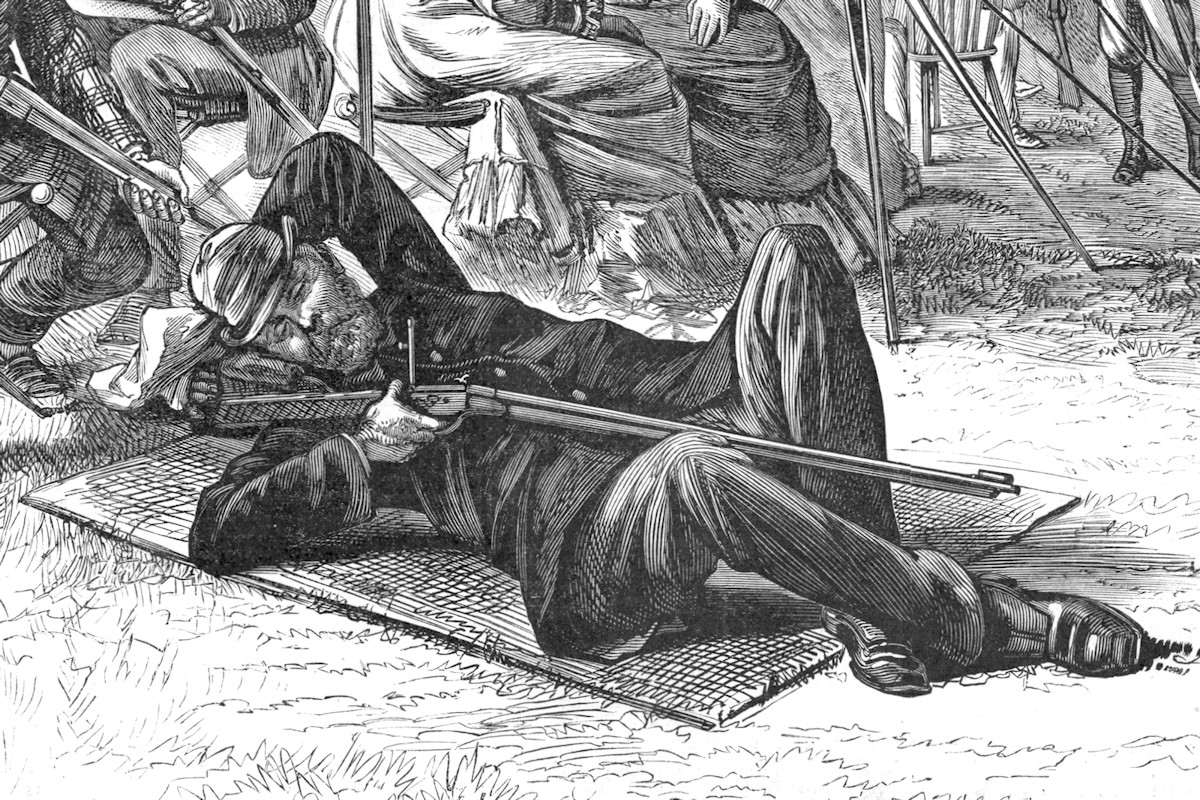
The Back Position
The back or supine position (sometimes referred to as the Creedmoor position) was known at the end of the 18th century. Captain Ferguson demonstrating his famous breech loading flintlock rifle at Woolwich in 1776 was noted to have “hit the bull’s eye at 100 yards, lying with his back on the ground.”
Record Breaking (Long Range) Scores
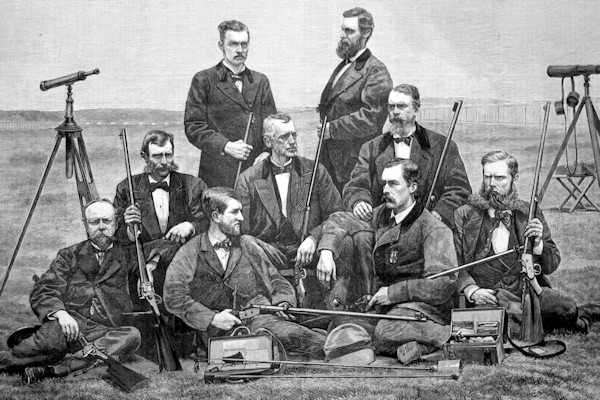
In 1878 Joseph Partello made the outstanding long range score of 224 x 225, shooting at 800, 900 and 1000 yards. Partello’s score was made at practice, experimenting having decided to change the method of loading the cartridges for his Remington rifle. However, and irrespective of Partello’s obituary statement in 1934 that his record score has “existed since 1878”, it was equalled by others.
Rifle Volunteers vs National Guard (1882 & 1883)
A shooting competition between the Rifle Volunteers of Great Britain and the National Guard of America was agreed for 1882. On 14 and 15 September the teams of twelve met at Creedmoor in the USA. The match was fired at 200, 500 and 600 yards on the first day, and at 800, 900 and 1000 yards on the second. In 1883 the American National Guard team had a return match against the British Volunteers at Wimbledon, England, on 20 and 21 July. The rifles used were of military pattern, although not necessarily one authorised for service. Each man fired seven shots at each distance, and no cleaning between shots was permitted.
Bedding the Parker-Hale
It is perfectly possible to clean a muzzle loading Enfield type of rifle thoroughly without ever taking the barrel out of the wood. Do this and you will always have the same point of impact with the same load.
The 2000 yard Competitions
In 1865 the NRA(GB) instigated the first of two competitions held at the extreme range of 2000 yards. They were fired with muzzle loading rifles at Gravesend in 1865 and 1866 and were for rifles not exceeding 15lbs. in weight, with any description of sights. Rests, other than mechanical ones, were permitted.
Elcho Shield Anecdotes
In 1861 a challenge published in a Scottish newspaper that Scotland would shoot against England was taken up. The match was limited to Volunteers, in teams of eight, and was fired at 800, 900 and 1,000 yards. To perpetuate the match Lord Elcho, afterwards the Earl of Wemyss (pictured right), who was the first Chairman of the Council of the National Rifle Association, presented the Elcho Shield for annual competition. The first match took place in 1862 during the National Rifle Association Annual Rifle Meeting at Wimbledon, Surrey, in the south of England, with England emerging the winners.
Rival Rifles
Trials were held at Hythe in May 1860 to select a suitable rifle for use in the Queen’s Prize at long range. Mr. Whitworth and a deputation of Birmingham gun makers contested the trials, with the Whitworth rifle being the clear winner. With one exception, the Whitworth rifle continued to be issued to Queen’s Prize finalists until 1871, when for the first time the match was shot throughout with breech-loaders. The notable exception was in 1865, when the Rigby rifle was issued to Queen’s Prize finalists.
George Charles Gibbs (1859–1918)
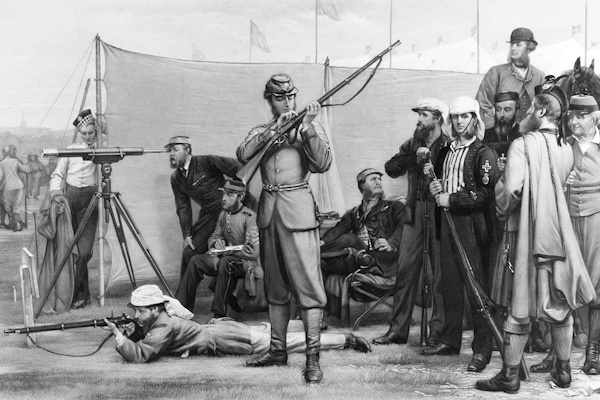
George C. Gibbs was a gifted shot and G.T Teasdale-Bucknell in his “Experts on Guns & Shooting” (1900) observed that he “would by rifle shots be conceded the first place in the British Islands as a long range rifle shot. This position G.C. Gibbs has gained by no single feat but by constant good shooting, varied only by occasional phenomenal feats.”