You are here: Home > Marksmanship > Military Marksmanship
With the evolution of British military muzzle loading long arms and ammunition, so to musketry instruction adapted with regards to the pressure to be applied with the ram rod when seating the ball/bullet. Following are brief extracts from various official publications, including editions of the British ‘Infantry Manual’ 1847-1857.
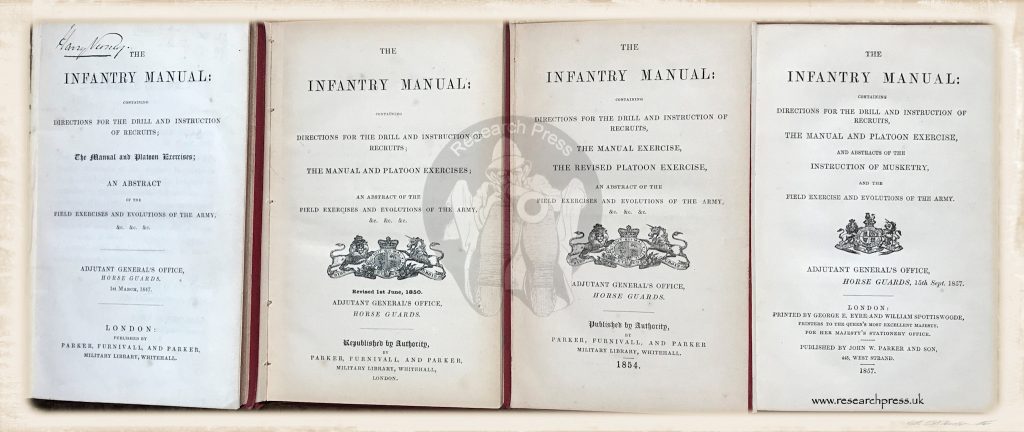
- ‘The Manual and Platoon Exercises’ 1792. “Push the cartridge well down to the bottom. Strike it two very quick strokes with the ramrod.”
- ‘Regulations for the Exercise of Riflemen and Light Infantry’ 1803. “The cartridge is put into the barrel and the ramrod seized with the forefinger and thumb of the right hand… .. The cartridge will be forced down the barrel with both hands.”
- ‘The Manual and Platoon Exercises’ 1804. “Push the cartridge well down to the bottom. Strike it two very quick strokes with the ramrod.”
- ‘The Manual and Platoon Exercises for Percussion Carbines’ (Royal Regiment of Artillery) 1844. “Push the cartridge quickly down to the bottom; knuckles to the front. Strike it two sharp strokes with the ramrod to drive it well home.”
- ‘The Infantry Manual’ 1847 & 1850 (and relating to the percussion musket). “Push the cartridge quick down to the bottom; knuckles to the front. Strike it two very sharp strokes with the ramrod, to drive it well home.”
- ‘The Infantry Manual’ 1847 & 1850 (and relating to the two-grooved Brunswick rifle). “The ball is forced down with both hands, giving two distinct strokes with the rod, to ensure its being so.”
- ‘The Infantry Manual’ 1854 (and relating to the P.51 Minie rifle). “Ascertain that the bullet is resting on the powder by two slight taps, avoiding all sharp strokes.”
- ‘The Infantry Manual’ 1857 (and relating to the P.53 Enfield Rifle Musket and Short Rifles). “By two steady and firm pressures (raising the ramrod about one-inch on each occasion) ascertain that the bullet is resting on the powder; all strokes which may indent the point of the bullet to be avoided.”