You are here: Home > Marksmanship > The Creedmoor Era
The year 1876 was an important one for America, being the centenary of the Declaration of Independence. Huge celebrations were planned, with exhibitions and festivities to be held in Philadelphia. The NRA put plans in place to mark the occasion with a rifle ‘Championship of the World,’ open to teams of eight from each Country, distance 800, 900, and 1,000 yards. They also gained approval from the National Centennial Commission to use its name in promoting the matches.
The final line-up of nations that accepted the invitation to compete in the Grand Centennial Rifle Contest was America, Australia, Canada, Ireland, and Scotland. In September 1876, the five nations competed at Creedmoor for the Centennial Trophy, later known as the Palma Trophy.
Course of fire was thirty shots at each range by each competitor. No sighting shots. The match lasted two days, with competitors firing fifteen shots at each distance each day, starting at 800 yards. The American team used breech loading rifles while their rivals contested the match with their trusted Rigby and Gibbs-Metford muzzle loading match rifles.
The morning of Wednesday, 13 September 1876, opened favourably for the riflemen with an overcast sky and little breeze, the banners and flags hanging almost motionless on their staffs. Wind strength increased a little in the afternoon and was a little more ‘puffy and baffling’ as one contemporary report states.
America took a 15 point lead over next placed Scotland at 800 yards. Edmond Johnson, for Ireland, made 15 consecutive bull’s-eyes for a maximum score of 75 at this distance. The teams shot more evenly at 900 yards, although the Americans’ strong lead narrowed slightly. The shooting opened briskly at 1,000 yards, the Irish and the Australians leading off, and finishing their rounds within an hour and a quarter. The Canadians and the Americans finished about together, but the Scots were still shooting with some deliberation. Despite the darkening afternoon the Scots continued without haste, consulting with each other after every shot, and emerged as the leaders after the first day of shooting.
The scores at the close of the first day were: Scotland 1,586 – Ireland 1,582 – America 1,577 – Australia 1,545 – Canada 1,490.
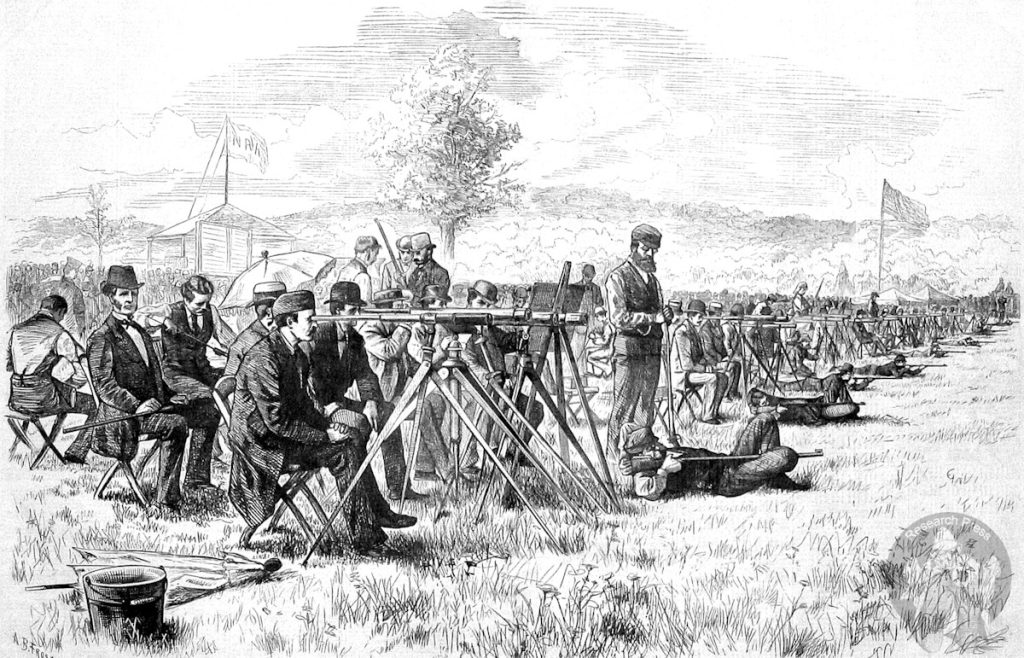
(Harper’s Weekly, 30 September 1876)
On 14 September 1876 spectators began to arrive on the early morning trains to watch the final day of shooting at Creedmoor for the Centennial Trophy.
Conditions were favourable, with pleasant sunshine, clear atmosphere and a steady brisk breeze. The cloud shadows, which travelled slowly from the marksmen toward the targets, were annoying to all, especially when a target that had been in shadow flashed out briefly in the strong sunlight. Toward evening, however, the sky cleared somewhat, and the light on the targets remained moderately bright.
Shooting at 800 yards, America tied with Scotland, the leaders after the first day. However, at the longer ranges, Scotland struggled, and Ireland came to be seen as the only competition to the Americans. The crowd’s anxiety grew as they watched Ireland, shooting with care and deliberation, progressively narrow the gap between them and America. Despite Ireland beating America by 26 points at 1000 yards, scoring 535 to 509, they could not assail the American lead.
The scores at the close of the second day of shooting were: America 1,549 – Ireland 1,522 – Australia 1,517 – Scotland 1,476 – Canada 1,433.
The most outstanding shooting was made by J.K. Millner of Ireland, who fired fifteen bull’s-eyes at 1,000 yards for an unprecedented maximum score of 75 x 75.
The Grand Aggregate scores were: America 3,126 – Ireland 3,104 – Scotland 3,062 – Australia 3,062 – Canada 2,923.
The Centennial Trophy was presented to the American Team by General Hawley at Gilmore’s Gardens on 15 September in the presence of 15,000 people. The match was fired again in 1877, but then faded away until a short revival in the early 20th century. The modern revival of the Palma Match commenced in 1966 and it is still fired today.
An international match, overlooked today, followed a week after the Grand Centennial Rifle Match at Creedmoor, on 21 September 1876. This was a return match between the old adversaries, America and Ireland.
Marking the 150th Anniversary of events
the full story of Creedmoor,
the 1874 match and the later
Palma Trophy match is published in
Research Press Digest 2024.

