You are here: Home > Marksmanship > The Creedmoor Era
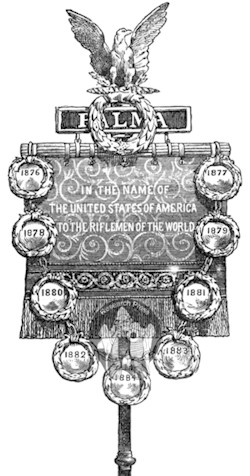
The International Rifle Trophy, awarded as a prize by the United States National Rifle Association to the victorious marksmen is a unique ork, both in design and in the remarkable effects produced by a combination of the different metals. The general idea is of a Roman triumphal standard, but wrought in metals, treated in a purely conventional manner. The trophy is about seven and a half feet high, and is formed of steel, inlaid with gold and silver, and otherwise enriched with elaborate mountings of copper. The staff is plain, smooth steel, with fillets of polished copper, and is surmounted by a foliated capital, above which is a panelled block, bearing, in lieu of the S.P.Q.R. upon the banners, the Latin word “Palma,” signifying prominence, valor, and victory. Hanging across the face of this is a silver laurel wreath. A finely sculptured copper eagle with raised wings surmounts the whole, and in his claws is held the fulmen (indicative of power), from which shafts of lightning and branches of laurels are wrought in silver. A fasces of copper is attached by massive links to the panelled box, and from it hangs the filed of the banner, which is enriched with a delicate scroll-work of gold superimposed upon steel, and across the face is the legend, in highly ornate letters of incrusted silver, “In the Name of the United States of America to the Riflemen of the World.” An elaborate gold frieze, in high relief, extends across the field, and attached to it at intervals are nine laurel wreaths of silver, inclosing each a plate of copper in which the dates from 1876 to 1884 are inlaid, and having each a space on which to engrave the name of the nation that shall each year send forth the victorious team. This trophy, from its originality, will attract attention in whatever country it may be held, and can not fail to excite admiration for the marvellous manipulation of metals which it presents. Many of the methods of decoration employed in its construction are new to us in this country, and it illustrates in a marked manner the taste and skill of Messrs. Tiffany & Co., the makers, as well as the vast resources of their workshops.
(Harper’s Weekly, 30 September 1876)